Ready-to-use
Organizations can select multisensory experiences for recovery, focus, readiness, relaxation, activation and engagement without asking users to learn another interface or technique.
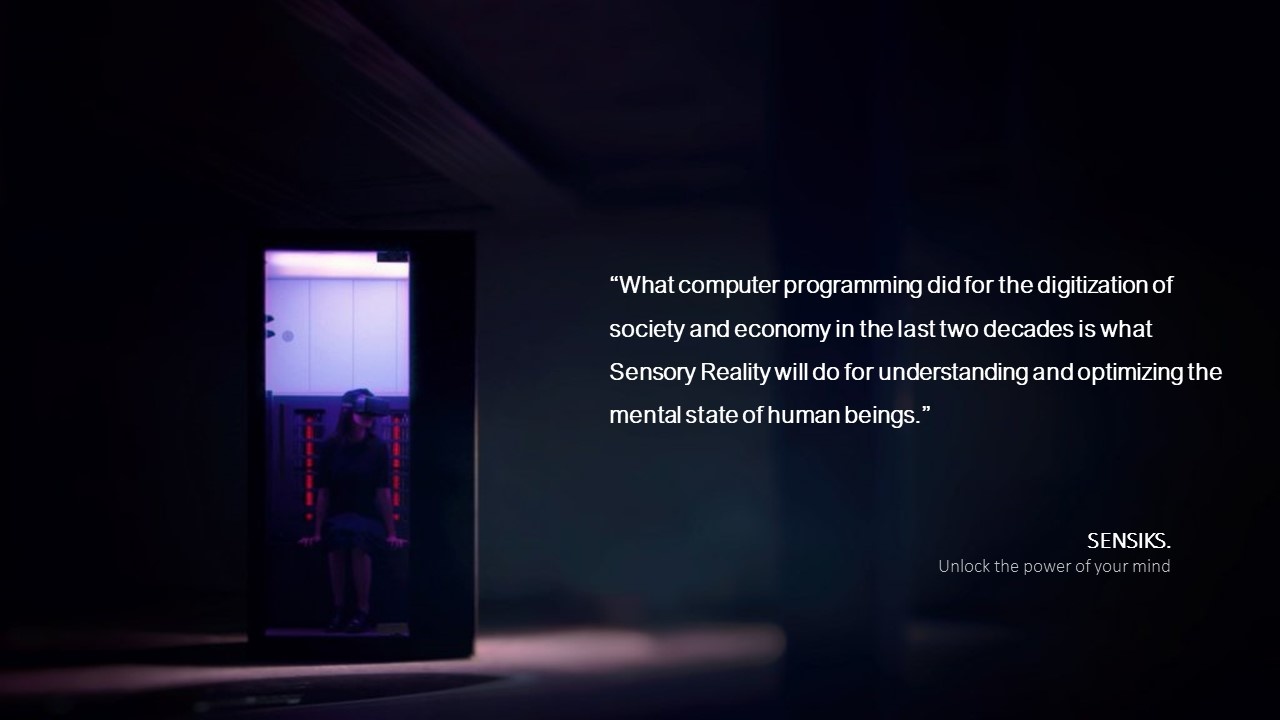
SENSIKS creates Sensory Reality Pods & Platform for organizations working on recovery, performance, quality of life, research and human wellbeing.
The platform coordinates digital content with the physical sensory environment around a person — bringing together sight, sound, scent, temperature, airflow, light and tactile effects in one controlled setting.
SENSIKS is an integrated hardware and software platform delivered through Sensory Reality Pods and compatible environments. Ready-to-use content makes the platform simple to deploy, while software control, optional physiological measurement and an SDK support advanced applications and research.
Organizations can select multisensory experiences for recovery, focus, readiness, relaxation, activation and engagement without asking users to learn another interface or technique.
Optional physiological signals such as heart rate, HRV, respiration and EDA can be aligned with the experience timeline to help teams observe response patterns.
Researchers and specialist teams can use SDK, API and integration tools to control supported sensory channels, integrate external sensors and build repeatable study protocols.
Digital technology has become extraordinarily sophisticated, yet most digital experiences still communicate through just two senses: sight and sound.
The physical world does not work that way.
Temperature, airflow, scent, light, sound, visual information and touch continuously combine to shape how we experience an environment.
SENSIKS was created to make those dimensions programmable.
Not simply to create more immersive media, but to give organizations and researchers a controlled platform for exploring what becomes possible when digital content and the physical sensory environment work together.

The same platform can be simple for the user while offering significant control and depth behind the experience.

Where relevant, SENSIKS can align physiological and external measurement with the session timeline.
Signals such as heart rate, HRV, respiration and EDA can provide an additional layer for pilots, evaluation and research when interpreted within the selected measurement protocol.
For research teams, this creates a controlled environment in which sensory variables, content and measurement can be brought together within repeatable protocols.
For other organizations, measurement remains optional — a tool for learning rather than a requirement for using the platform.
The Pod is the controlled delivery environment. SENSIKS is the broader platform combining physical sensory hardware, software, content, optional measurement and advanced integrations.
Controlled physical environments that bring coordinated multisensory experiences around the user.
Ready-to-use and bespoke experiences coordinating visual, audio, scent, temperature, airflow, light and supported tactile effects.
Controls timing, sequencing and supported sensory channels and synchronizes digital content with the physical environment.
Allows researchers, developers and specialist teams to build applications, integrate sensors and external content, and control supported sensory functions.
Optional physiological data can be aligned with the experience timeline for response analysis where relevant.
Advanced workflows can use response data and software logic to investigate and develop increasingly adaptive multisensory experiences.
StateShifter AI is a learning layer being developed to identify stimulus-response patterns and support increasingly adaptive multisensory experiences.
The aim is to help investigate how experience parameters and response data can inform future adaptive workflows, while keeping personalization as an evolving platform capability rather than a guaranteed physiological outcome.
Many digital wellbeing tools ask people to engage cognitively with another screen, interface or technique.
SENSIKS takes a different approach: coordinate the physical sensory environment around the user and make the experience simple to receive.
That principle connects our work across workplace recovery, care, research and experience innovation.
Our focus is not on claiming a single guaranteed outcome. It is on building a controlled, measurable and increasingly adaptive platform that organizations and researchers can use to explore how multisensory environments support human experience and wellbeing.

For those interested in how SENSIKS developed, the platform grew from an observation about the influence of physical environments into years of multisensory research, engineering, collaboration and real-world deployment.
In 2011, after an intense period of work, our founder noticed how quickly a change of environment affected how he felt. Light, the sound of waves, warmth and salt air worked together as one experience. It raised a simple question: if an environment can shape a moment so strongly, could those sensory conditions be coordinated by design?
That question became SENSIKS. The concept developed with input from Delft University of Technology and high-tech partners from the Eindhoven and Delft regions.
Through knowledge-sharing projects and research collaborations, SENSIKS explored neuroscience, psychophysiology, multisensory perception, engineering and interaction design to understand how sensory channels can be coordinated in a controlled environment.
The practical challenge became increasingly clear: synchronize sensory channels, make conditions repeatable, connect content and software, and — where useful — align physiological measurement with the session timeline.
SENSIKS Pods are manufactured in the Netherlands using digital manufacturing. The system combines a compact physical delivery environment with a content platform and library, plus optional SDK access for advanced integrations and research.
Over time, the technology developed from an experimental concept into a platform that can be configured for workplace, care, research and innovation environments.
Our team and partnership network brings together engineers, product developers, researchers and academic expertise. Government-supported innovation projects and collaborations have contributed to the development of SENSIKS over the years.
Everything still comes back to the first observation: environments matter. Today, our focus is on making multisensory technology practical to deploy, measurable where relevant, programmable for research and increasingly adaptive over time.
Sensory Reality Pods & Platform for workplace recovery and performance, quality of life and engagement in care, programmable multisensory research and experience innovation.
One Sensory Reality platform supports four application fields, with Workplace and Care focused on practical day-to-day use, Research providing programmable depth, and Innovation extending the same technology into new environments and formats.
SENSIKS gives organizations a dedicated multisensory environment for short, ready-to-use experiences during demanding workdays. Sessions can be selected for recovery, focus, readiness or activation, with minimal active cognitive effort and optional measurement where relevant.
Explore Workplace →
SENSIKS enables care teams to offer coordinated multisensory experiences without requiring users to learn an interface or technique. Experiences can be selected for relaxation, sensory activation, engagement and meaningful moments, with optional customization for the setting.
Explore Care →
SENSIKS provides researchers with a programmable environment for coordinating sensory variables, creating repeatable experimental conditions and aligning multisensory experiences with physiological or external sensor data.
Explore Research →
The same platform can also extend content and physical spaces into coordinated multisensory experiences for education, events, culture, hospitality and other innovation projects.
Explore events →